Octopus-Inspired Embodied Tactile Intelligence: A Universally Calibrated Miniature Vision-Based Suction Cup
Bio-inspired robotics · TMECH 2026
Small cup.
Deep sense of touch.
Before a robot can lift something delicate, it needs to understand how it touches it.
Inspired by the octopus, our miniature suction cup uses a camera to sense contact — turning deformation into force and orientation estimates for closed-loop alignment.
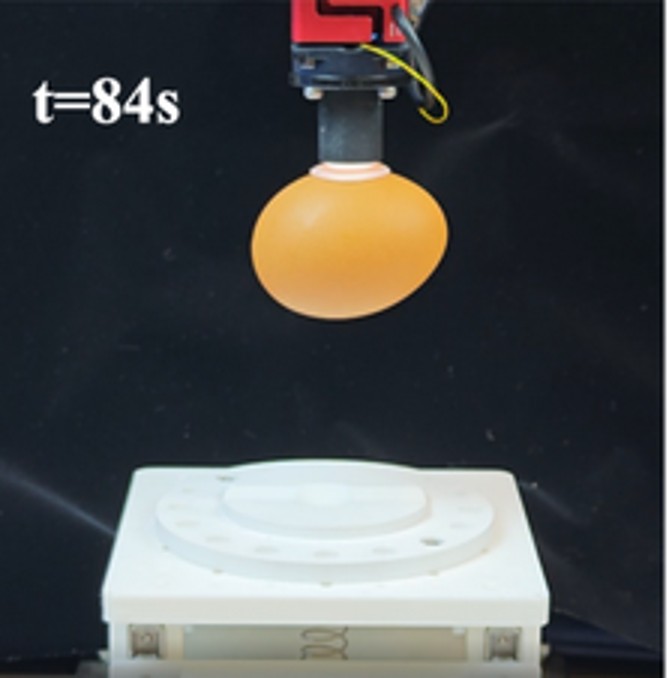
Detail from the egg pickup experiment.
01 / The challenge
Grasping starts before the lift.
Small, curved objects rarely meet a robot at the perfect angle.
A suction cup must establish contact and a seal. With delicate objects, simply pressing harder is not the answer. Contact orientation and pressing force provide the feedback needed to adjust the approach.
Our approach brings that sensing into a 22 × 40 mm suction cup, rather than treating touch and attachment as separate functions.
02 / Previous work
From optical touch sensing to a miniature multimodal cup.
This project builds on a wider effort to make suction cups sense contact, not only attach to surfaces.
FIELD OVERVIEW · 2024
What should an intelligent sucker do?
A review of octopus-inspired suction cups maps design and evaluation challenges, including tactile sensing, adhesion under imperfect contact and integration with soft continuum robots.
van Veggel et al., Advanced Science ↗DIRECT PREDECESSOR · 2025
Seeing how a cup touches.
An earlier optoelectronically innervated cup used a camera to track markers embedded in the compliant structure, estimate contact orientation and reorient for a perpendicular approach.
van Veggel et al., Advanced Intelligent Systems ↗THE GAP THIS PAPER ADDRESSES
The camera-based predecessor focused on contact orientation. The 2026 study targets a more compact cup that estimates force and orientation together, while addressing the need for per-device calibration across manufactured units.
The project’s earlier compact-cup direction was presented as ongoing work at the 2025 Conference on Robots for Science (SRC).
03 / Research contributions
What this study adds.
The paper’s contributions are at the system level: a compact sensor, a shared tactile model and a robot that uses its estimates to improve contact.
Miniaturized sensing
A 22 × 40 mm suction cup integrates an internal camera for vision-based tactile sensing.
Force + orientation
The system estimates three-axis pressing force together with contact pitch and roll.
One model, same design
A shared model applies across suction cups of identical design, without individual per-unit calibration.
Estimates guide action
Closed-loop perpendicular approaches were demonstrated in handling small, delicate, misaligned and curved objects.
The quantitative estimation errors are reported in the evidence section below; they are not grasp-success rates or adhesion-strength measurements.
04 / From deformation to information
A camera that looks inward.
The cup’s deformation becomes its tactile signal.
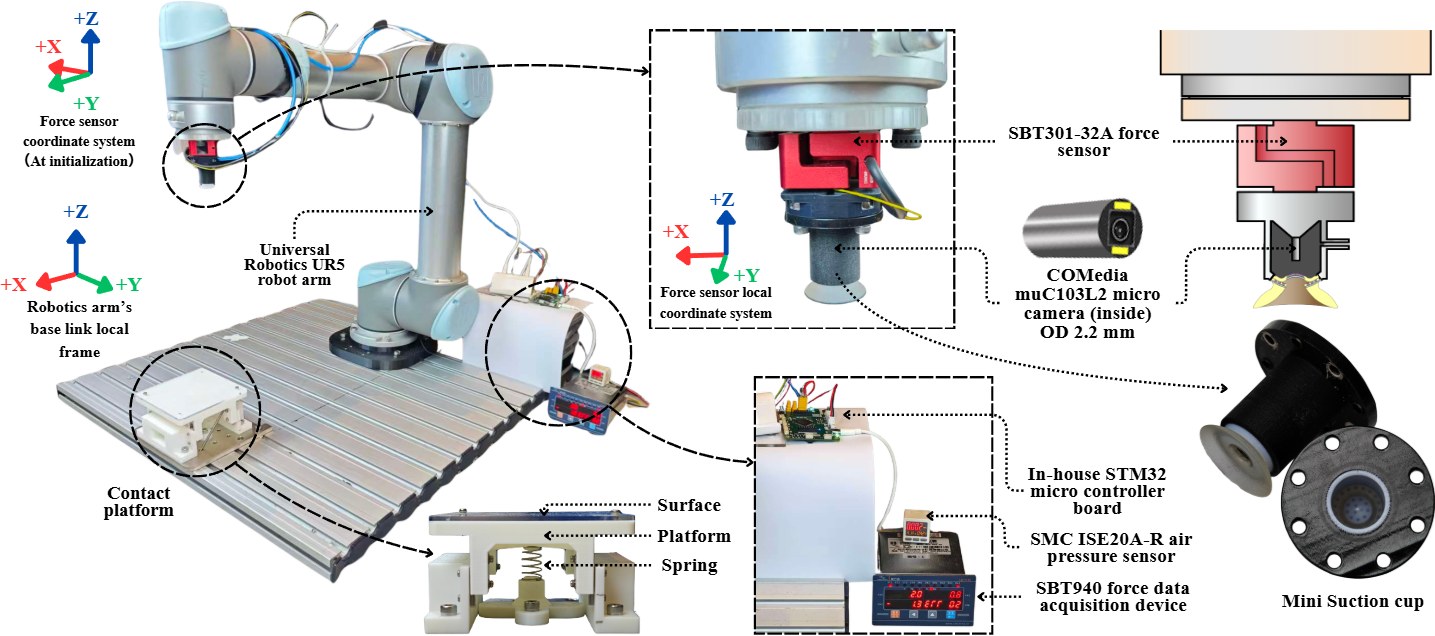
A micro-camera observes the sensing markers inside the cup. Comparing contact images with the non-contact reference reveals changes that a prediction model uses to estimate three-axis pressing force and contact orientation.
Universally calibrated, not universally applicable. Devices with the same design can share a model without per-unit calibration. This does not imply transfer to arbitrary suction cups or every surface.
The compliant cup deforms on contact.
The internal camera captures the visual change.
A shared model predicts force, pitch and roll.
The robot corrects its contact orientation.
Look inside the experimental system
05 / Closing the loop
Touch. Align. Attach. Lift.
Not a blind pickup: contact feedback informs the next movement.
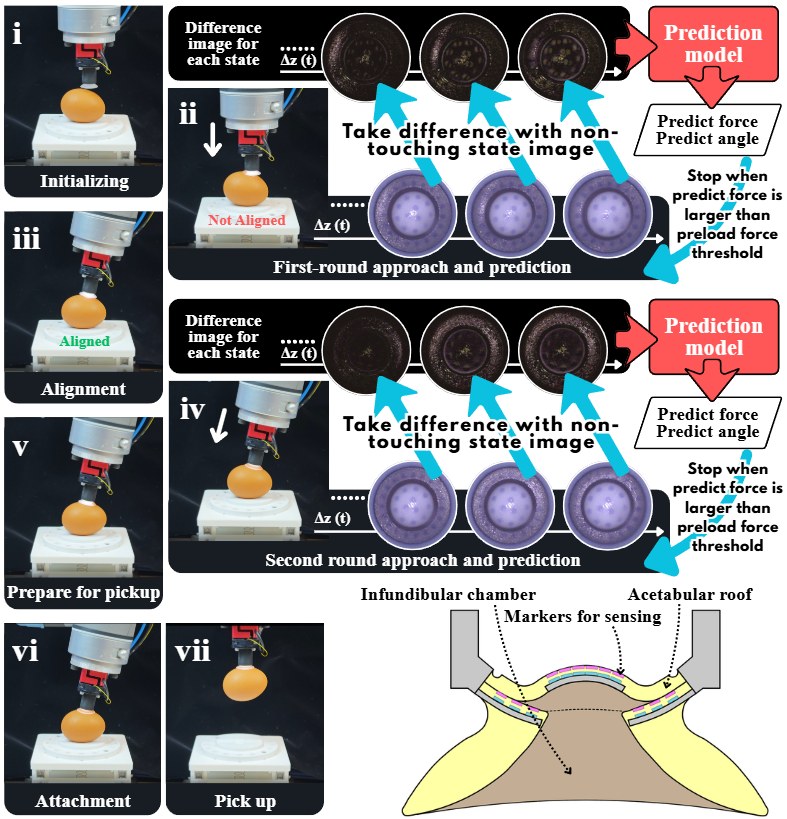
- 01 / Approach
Make contact, then listen.
The robot approaches the surface. Differences from the non-contact image supply the visual input for force and orientation prediction.
- 02 / Align
Correct the angle.
Estimated contact orientation guides robot realignment. The cup approaches again, using predicted pressing force to limit the contact preload.
- 03 / Attach
Establish the seal.
After alignment and preparation for pickup, the cup attaches to the object. Sensing and suction serve distinct roles: understanding contact, then securing the grasp.
- 04 / Lift
Carry something delicate.
Egg and tomato demonstrations show the process on curved, delicate objects. These examples illustrate the method, not a guarantee of success on every object.
Explore the full tomato and egg sequences
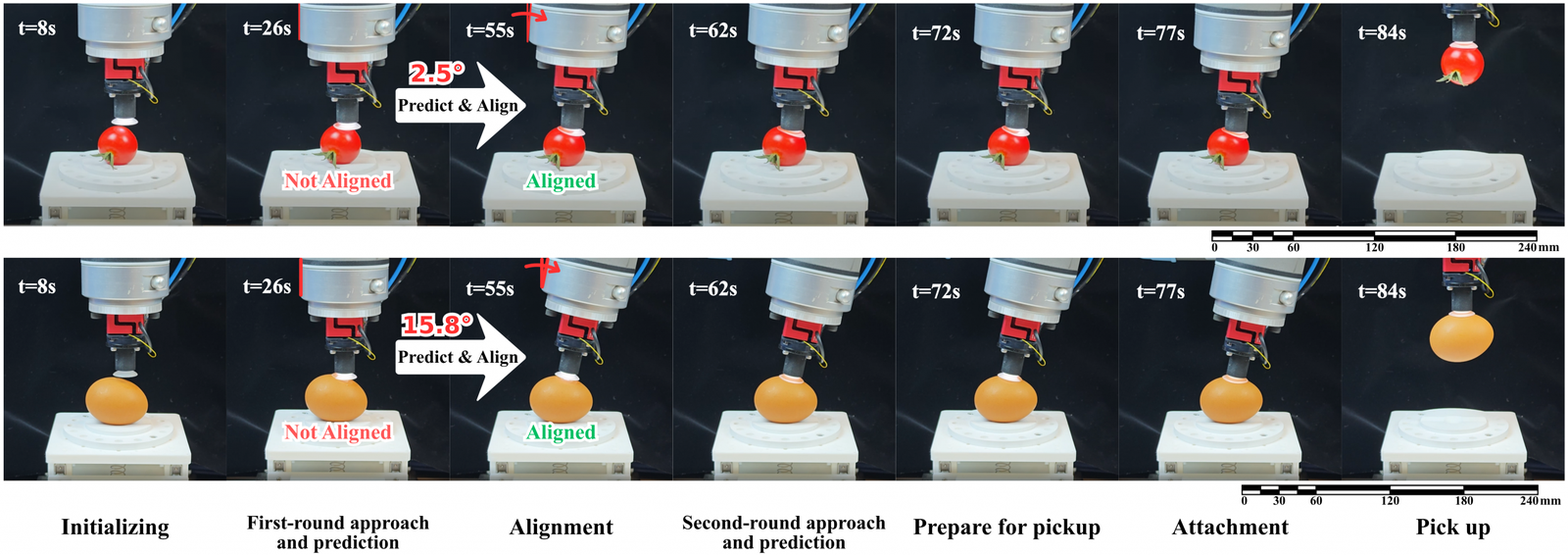
Watch the experimental demonstration · Open on YouTube ↗
06 / Quantitative evidence
What does the cup measure?
Reported mean absolute errors (MAE). Orientation and force are different quantities — shown separately, in their own units.
Contact orientation
- Pitch
- 1.43° MAE
- Roll
- 1.45° MAE
Pressing force
- Fx
- 0.254N MAE
- Fy
- 0.256N MAE
- Fz
- 0.763N MAE
Source: published IEEE abstract. These are estimation errors, not adhesion strength, maximum payload or grasp-success rates. See the paper for experimental conditions and evaluation protocol.
What is demonstrated
Compact vision-based tactile sensing; shared calibration across identically designed devices; closed-loop alignment and real-world handling of small, delicate, misaligned and curved objects.
What remains open
The reported demonstrations do not establish performance on every material, surface texture or geometry. Broader surface testing, long-term durability and transfer beyond the same device design are useful directions for future evaluation, not results claimed here.